



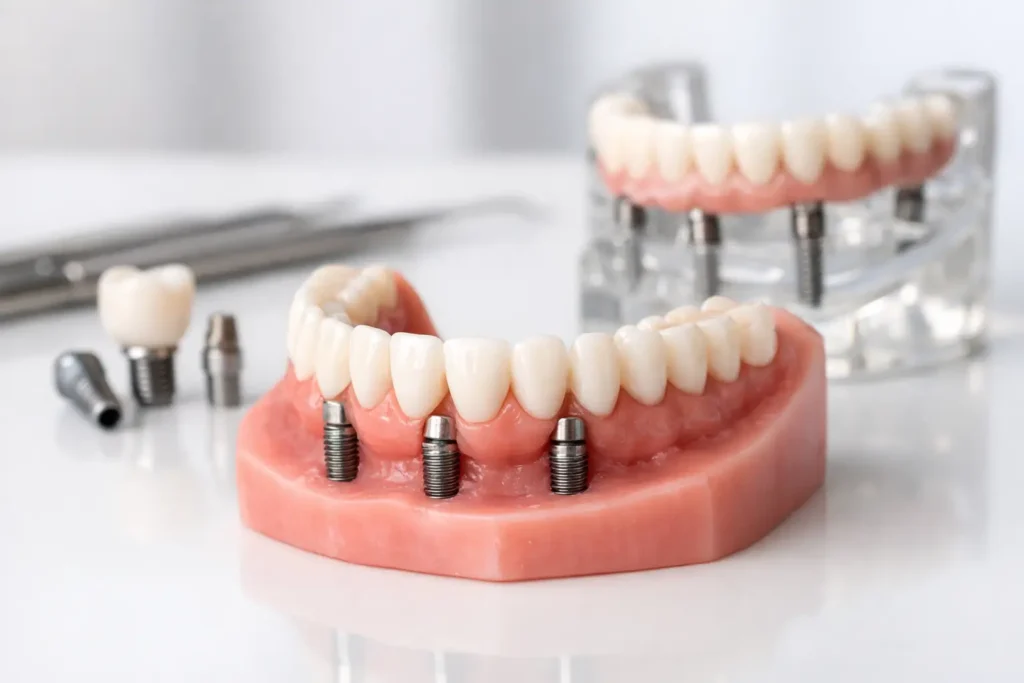
If you are tired of loose dentures, failing teeth, or repeated dental work that never seems to last, full arch dental implants can feel less like a cosmetic upgrade and more like getting your life back. For many patients, the real goal is simple – eat comfortably, speak clearly, smile without hesitation, and stop planning daily life around their teeth.
That is why a good guide to full arch dental implants should do more than define the procedure. It should help you understand who this treatment is for, what the process really looks like, where the trade-offs are, and how to make a smart decision before committing to surgery.
What full arch dental implants actually are
Full arch dental implants replace all the teeth in the upper arch, lower arch, or both using a fixed prosthesis supported by dental implants. Instead of replacing each missing tooth with a separate implant, your dentist places a strategic number of implants – often four, six, or eight per arch – and secures a full set of teeth to them.
You may hear terms like All-on-4, full mouth implants, implant-supported arches, or fixed hybrid dentures. The concept is similar, but the exact treatment plan can vary. The number of implants, the type of final bridge, and whether extractions or bone reduction are needed all depend on your anatomy and your long-term goals.
For the right patient, this approach offers a major advantage over removable dentures. The teeth are fixed in place, which means more stability, stronger biting function, and a result that generally feels closer to natural teeth.
A practical guide to full arch dental implants candidacy
Not every patient starts in the same place. Some have already lost most of their teeth. Others still have several natural teeth, but those teeth are weak, infected, severely worn, or too compromised to save predictably. In those cases, full arch treatment may be more practical than continuing with multiple crowns, root canals, bridges, and partial dentures.
Good candidates usually include patients who have extensive tooth loss, advanced decay, gum disease damage, broken-down dental work, or long-term denture frustration. General health matters too. Conditions like uncontrolled diabetes, heavy smoking, or certain medications can affect healing, but they do not always rule treatment out. It depends on the details and on how well the case is planned.
Bone volume is another factor, but not always in the way people expect. Even if you have been told you have bone loss, you may still qualify for full arch implants because the implants can often be placed in areas where bone is strongest. Advanced imaging and surgical planning are what determine that, not guesswork.
What the treatment process usually looks like
The first step is diagnosis. This should include a clinical exam, digital imaging such as a CBCT scan, photographs, and a review of your bite, gum health, and medical history. If you are traveling for treatment, this planning stage becomes even more important because your schedule, healing time, and restoration design all need to be coordinated carefully.
Once the records are complete, your dental team determines whether the case can be done with immediate loading or whether healing time is needed before placing the final teeth. Immediate loading means a temporary fixed prosthesis is attached soon after implant surgery, often the same day or within a short window. For many patients, this is one of the biggest benefits because they do not leave with no teeth.
If failing teeth are still present, those teeth are removed first. The implants are then placed into the jawbone, and a temporary arch may be delivered while the implants heal and integrate. After the healing phase, the final prosthesis is made. This final arch is stronger, more refined, and designed for long-term function and appearance.
Temporary teeth versus final teeth
This is one area where expectations need to be realistic. Temporary teeth are not the same as final teeth. They are often lighter and simpler by design because their job is to support healing, maintain appearance, and allow function during the integration period.
Your final prosthesis is where fit, bite, esthetics, and material choice become more customized. Depending on the case, it may be made from acrylic over a reinforced framework, zirconia, or another restorative material. Each option has trade-offs. Acrylic-based restorations can be more affordable and easier to repair, while zirconia is often chosen for strength, stain resistance, and a more premium finish. The right choice depends on budget, bite force, esthetic goals, and the recommendations of your restorative specialist.
How long full arch implant treatment takes
The timeline depends on your starting point. If you need extractions, bone reshaping, or a staged approach, treatment can take longer than a straightforward implant case. Some patients receive implants and temporary teeth during one trip, then return later for the final restoration after healing. Others may qualify for a shorter sequence.
This is especially relevant for dental tourism patients. A realistic plan should account for surgical recovery, follow-up visits, and the fabrication time needed for the final prosthesis. Clinics that combine surgical, restorative, and lab work under one roof can often move more efficiently because fewer steps depend on outside providers.
Cost, value, and what patients should compare
Full arch dental implants are a major investment, but they are often more cost-effective than years of patchwork dentistry on failing teeth. If you are comparing treatment options, do not focus only on the starting price. Look at what is included and who is actually providing the care.
A lower quote may not include imaging, extractions, sedation, temporaries, the final bridge, or follow-up adjustments. It may also not tell you whether a general dentist is handling the whole case or whether specialists are involved. For full arch treatment, that distinction matters. Implant placement, bite design, tissue management, and prosthetic planning all affect the outcome.
For many US and Canadian patients, seeking treatment in Costa Rica can make this level of care much more attainable. At Colina Dental, patients benefit from specialist-led planning, modern 3D digital dentistry, an on-site lab for greater efficiency, and hospitality support designed specifically for international care. When treatment is complex, convenience is not a luxury. It is part of a safer, more predictable experience.
Recovery and adjustment after surgery
Most patients can expect swelling, soreness, and some dietary restrictions after implant surgery. The first few days usually require rest and careful attention to instructions. A soft-food diet is common, especially when temporary teeth are in place and the implants are still healing.
The adjustment is not only physical. Speaking may feel different at first, and your bite can take time to get used to. That is normal. Follow-up visits are part of the process, not a sign that something is wrong.
Healing also depends on habits. Smoking, poor home care, and ignoring food restrictions can compromise results. Full arch implants are fixed, but they are not maintenance-free. Daily cleaning and regular professional maintenance remain essential.
Common concerns patients have before saying yes
One common concern is whether full arch implants look fake. A well-planned case should not. The best results come from careful prosthetic design, proper lip support, natural tooth proportions, and close coordination between the surgical and restorative team.
Another concern is pain. Most patients report that the procedure is more manageable than they expected, especially when the case is organized well and post-op instructions are clear. Anxiety is often higher before treatment than discomfort is afterward.
Patients also ask whether removable dentures are still a better choice. Sometimes they are. If someone has health limitations, a very tight budget, or anatomy that makes fixed treatment less predictable, a removable option may be the smarter decision. Fixed full arch implants offer major lifestyle benefits, but they are not automatically the best answer for every patient.
Questions worth asking at your consultation
Before moving forward, ask who will place the implants, who will design the final teeth, what materials are being used, what happens if bone loss is present, and whether your quote includes both temporary and final restorations. You should also ask about expected time in the country, follow-up care, and how complications are handled if you live far from the clinic.
Good providers welcome these questions. Full arch treatment is too significant for vague answers.
Choosing full arch dental implants is not just about replacing teeth. It is about choosing a long-term solution that fits your health, your budget, and your daily life. When the case is planned carefully and delivered by the right team, the result can be life-changing in a very practical way – more comfort, more confidence, and far fewer compromises every time you sit down to eat or smile.