



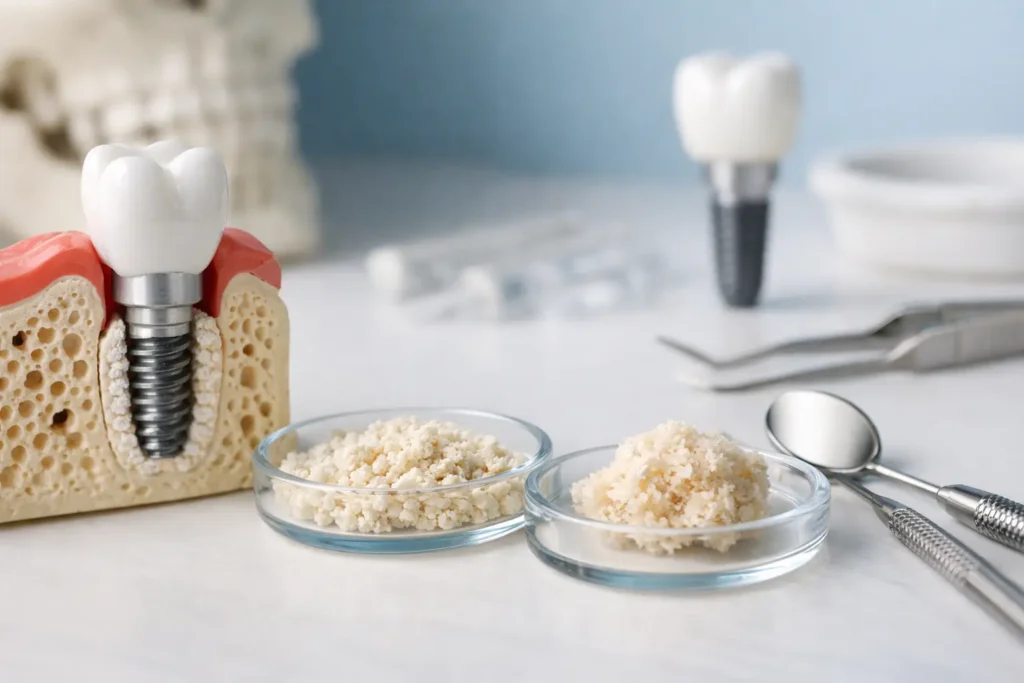
Losing a tooth is one problem. Hearing that you may not have enough bone for a dental implant can feel like a second one.
That usually happens after a tooth has been missing for a while, after gum disease, or when the upper back jaw sits too close to the sinus. The good news is that limited bone does not automatically rule out implants. In many cases, the right grafting approach can rebuild support and make treatment possible.
For patients comparing treatment in the US or Canada with care abroad, this is where planning matters most. Bone grafting is not a one-size-fits-all add-on. It should be selected based on your anatomy, your timeline, the number of implants needed, and the kind of final restoration you want.
Understanding bone grafting options for dental implants
A dental implant needs enough healthy bone around it to stay stable long term. If the ridge is too narrow, too short, or weakened by infection or tooth loss, a graft may be recommended before or during implant placement.
When people search for bone grafting options for dental implants, they are usually asking two questions at once: What type of graft material will be used, and what kind of procedure will I need? Those are related, but they are not the same thing.
The material could come from your own body, a donor source, an animal source processed for medical use, or a synthetic material. The procedure might be a socket preservation graft after extraction, a ridge augmentation to widen the jaw, a sinus lift in the upper back jaw, or a smaller localized graft around an implant site.
That distinction matters because the best choice depends less on what sounds most advanced and more on what your bone is missing.
Why bone loss happens before implant treatment
Bone starts to shrink when a tooth is lost because the jaw is no longer being stimulated by the tooth root. The longer the gap remains, the more the ridge can collapse in width and height. Denture wear can also accelerate bone loss over time.
Periodontal disease is another major factor. If infection has damaged the surrounding structures, the bone may not be strong enough to support an implant until the area is treated and rebuilt. Trauma, failed root canals, and old extractions can create similar defects.
In the upper back jaw, anatomy creates a different issue. The sinus cavity can expand downward after teeth are lost, leaving very little vertical bone. In those cases, the solution may not be a standard graft alone but a sinus augmentation.
The main graft material choices
Autograft means bone taken from your own body. This is often considered the strongest biological option because it contains your own living cells and growth factors. It can work very well, but it also means a second surgical site if bone must be collected from another area. For many patients, that extra step is the main trade-off.
Allograft is donor bone that has been safely processed for medical use. It is commonly used in implant dentistry because it avoids a second harvest site and performs well in many routine grafting cases. Patients often prefer it because treatment is simpler and recovery may be easier.
Xenograft is typically a bovine-derived material processed to be biocompatible. It is often chosen because it helps maintain space and volume, especially in socket preservation and sinus grafting. It can be an excellent option when the goal is to support gradual bone formation while preserving shape.
Synthetic graft materials are man-made substitutes designed to support bone regeneration. These can be useful in selected cases and appeal to patients who prefer not to use donor or animal-derived material. The trade-off is that performance depends heavily on the defect type and the overall treatment plan.
In real practice, specialists often use a combination rather than one material alone. A mixed approach may offer better stability, better contour, or a more predictable healing pattern.
Common procedures used before implants
Socket preservation
This is done at the time of extraction. Instead of leaving the socket to collapse as it heals, the dentist places graft material to preserve the ridge for a future implant. It is one of the smartest ways to reduce the need for larger grafts later.
Not every extraction site needs it, but when an implant is planned, preserving the bone early can save time, cost, and complexity.
Ridge augmentation
If the jaw has become too thin or too short, ridge augmentation builds it back up. This may be needed when a tooth has been missing for years or when infection has caused significant damage.
This type of graft can be minor or more involved depending on the defect. In some cases, the implant is placed later after healing. In others, it may be possible to graft and place the implant at the same time if enough initial stability is available.
Sinus lift
A sinus lift is used in the upper back jaw when there is not enough vertical bone under the sinus floor. The membrane is gently raised, and graft material is placed to create room for future implant support.
This sounds intimidating to many patients, but it is a well-established procedure in implant dentistry. Whether it can be done at the same time as implant placement depends on how much native bone remains.
Minor grafting around an implant
Sometimes the site is almost ready, but not perfect. A small graft may be placed around the implant during surgery to improve contour or fill a localized defect. This is different from a major rebuild and often carries a shorter healing timeline.
How dentists decide which option fits your case
The best treatment plan starts with 3D imaging, not guesswork. A cone beam CT scan shows bone width, height, density, sinus position, and hidden defects that cannot be fully evaluated on a regular X-ray.
From there, the treatment team looks at several factors. How many teeth are missing matters. A single front tooth has different esthetic demands than a full-arch case. Your medical history matters too, especially if you smoke, have uncontrolled diabetes, or have had active gum disease.
Timing is another major factor. Some patients want the fastest route to a fixed solution. Others are willing to stage treatment if it improves predictability. Neither approach is automatically better. The right decision depends on your anatomy and your priorities.
For complex restorative care, this is where a multi-specialty team makes a real difference. Surgical planning, implant placement, and the design of the final teeth should work together from the beginning, not as separate decisions made along the way.
Healing time and what to expect
Healing after a bone graft can range from a few months to longer, depending on the procedure size and the material used. A socket graft may be ready for implant placement in a shorter window, while a larger ridge augmentation or sinus graft can require more time.
Patients often ask whether bone grafting is painful. Most describe the recovery as manageable, especially when the procedure is carefully planned and post-op instructions are clear. Swelling and soreness are expected for a few days, but the experience varies based on the size of the graft and whether more than one area was treated.
The bigger issue is not usually discomfort. It is patience. Rushing to place an implant before the graft has matured can compromise stability. Good implant dentistry is not about speed at any cost. It is about choosing the shortest safe path to a lasting result.
Cost, value, and why cheaper is not always better
Bone grafting adds cost to implant treatment, but skipping a necessary graft can create a bigger expense later if an implant fails or the esthetic result is poor. The better question is not how to avoid grafting at all costs. It is whether the proposed graft is genuinely necessary and appropriate for your case.
For many patients traveling for treatment, value means balancing specialist care, technology, and efficient scheduling. A clinic that can evaluate your scan, coordinate surgery and restoration, and manage recovery in one place reduces uncertainty. That matters even more when you are arranging flights, time off work, and lodging.
At Colina Dental, that coordinated model is part of what makes complex implant care more practical for international patients. When surgery, restorative planning, digital imaging, and patient support are aligned, treatment becomes easier to understand and easier to complete with confidence.
Questions worth asking before you say yes
If a graft has been recommended, ask what type of defect you have, what material will be used, whether the implant can be placed at the same time, and how long healing should take in your case. Ask what happens if no graft is done and what trade-offs come with each option.
Those answers should be clear and specific. If they are vague, you are not really being given a treatment plan. You are being given a sales pitch.
The right bone graft is not the biggest one or the most expensive one. It is the one that creates enough healthy support for a stable implant and a result that still looks and functions well years from now. If you are considering implants and have been told you do not have enough bone, that is not the end of the conversation. It is the point where expert planning starts to matter most.