



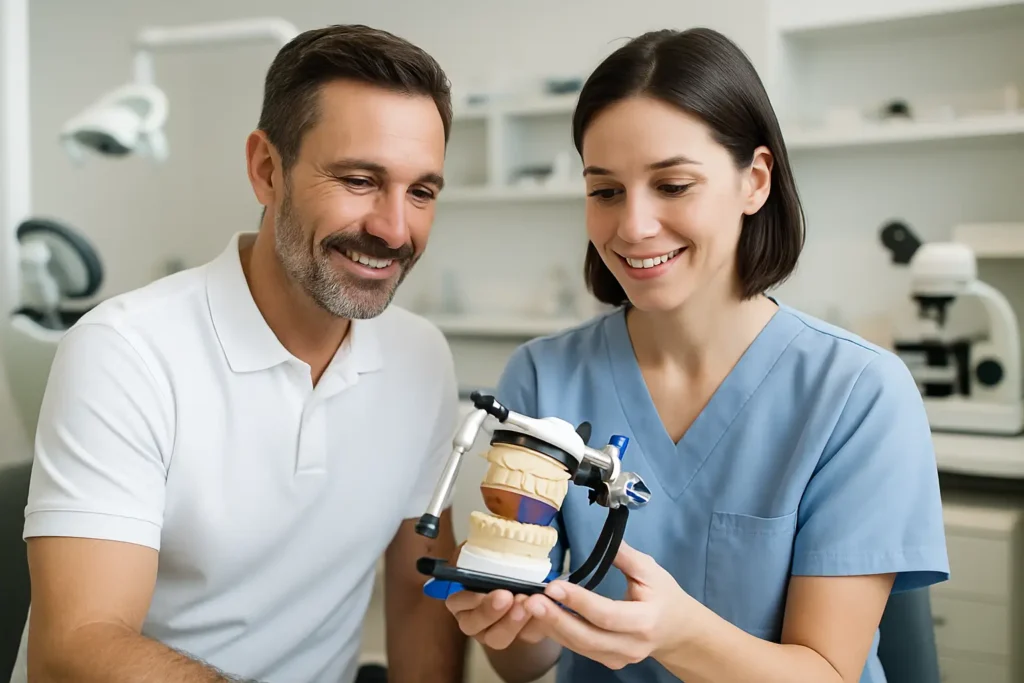
You can usually tell when a dental case is going to be complicated – not because it is scary, but because it is specific. A front-tooth crown has to match your natural smile in color and shape. A full-arch implant bridge has to fit precisely on day one, not “almost” fit after two remakes. And when you are traveling for treatment, the biggest question is simple: how many appointments will this take, and what happens if something needs adjusting?
That is where an on-site dental lab stops being a behind-the-scenes convenience and becomes a real clinical advantage. Instead of sending your case out and waiting, your dentist and lab team can work in the same building, in the same timeline, with the same standards. The result is often faster, more predictable, and more comfortable – especially for patients coming from the US or Canada for restorative and cosmetic dentistry.
The real benefits of an on site dental lab
Most patients hear “on-site lab” and think only about speed. Speed is part of it, but the bigger story is control. When the lab is integrated with the clinic, your dentist can manage the details that affect how your restoration looks, feels, and lasts.
The benefits of an on site dental lab tend to show up in four practical areas: turnaround time, precision and fit, aesthetics, and the ability to make adjustments without derailing your schedule.
1) Fewer delays when timing matters
When a crown, veneer, denture, or implant restoration is made off-site, you are dependent on shipping, lab queue times, and back-and-forth communication. That can be fine for straightforward cases near home, but it becomes less ideal when you are trying to complete treatment within a travel window.
With an on-site lab, the lab team can often begin work quickly after your scan or impression. If the dentist needs a tweak – margin refinement, contact adjustment, shade change – it can be addressed in hours or days rather than adding a week.
For dental tourism patients, this time compression is not just about convenience. It reduces the number of “buffer days” you need to build into your trip. It can also reduce the risk that you leave the country wearing a temporary for longer than planned.
2) Better fit through tighter clinical feedback
A restoration’s fit is not an abstract technical detail – it affects comfort, hygiene, and longevity. A crown with a poor margin can trap plaque and irritate the gumline. Contacts that are too tight or too open can make flossing miserable or cause food packing. Bite discrepancies can lead to soreness or fractures.
An on-site lab improves fit because the dentist and lab technician can collaborate in real time. When a case is in-house, a technician can look at the scan data, ask questions, and even review the patient’s bite and esthetic goals directly with the clinical team. That short feedback loop helps catch small issues before they become big ones.
This matters even more in complex restorations like full-mouth rehabilitation or full-arch implant bridges, where multiple pieces must work together. Precision is not optional – it is the difference between a restoration that feels “like you” and one that feels like something you are constantly aware of.
3) More control over esthetics for smile-zone work
If you are investing in cosmetic dentistry – porcelain veneers, anterior crowns, implant crowns in the smile zone – the outcome depends on details most people cannot name but immediately notice. Incisal translucency, surface texture, line angles, and shade mapping all affect whether a tooth looks natural or looks like dentistry.
In a clinic with an on-site lab, shade selection and characterization can be more intentional. The dentist can communicate the plan directly to the technician, using photos, digital smile design references, and real-time feedback. When the lab is steps away, it is easier to refine a case until it matches your face, your age, and your preferences.
This is especially valuable when patients want a specific look – bright but not flat, symmetrical but not “too perfect.” That kind of customization is hard to achieve when communication is delayed or simplified.
4) Faster adjustments when your mouth says “almost”
Even with excellent planning, dentistry sometimes needs micro-adjustments. Your bite settles, your gums respond to new contours, and your tongue and cheeks notice anything that is slightly off.
With an off-site lab, small changes can mean sending work back out, waiting, and returning for another visit. With an on-site lab, many adjustments can be handled quickly. That can include reshaping bite contacts, refining a denture flange, modifying emergence profiles around implants, or polishing and finishing for comfort.
For traveling patients, this is a major relief. It is one thing to need a quick tweak. It is another to need a quick tweak that becomes a scheduling problem.
Where an on-site lab matters most: real treatment scenarios
Not every procedure depends on a lab. A filling or a routine cleaning is primarily chairside work. But for restorative and cosmetic care, the lab is part of the treatment – and the more complex the case, the more you benefit from having the lab integrated.
Crowns and bridges
Crowns and bridges live or die by fit and bite. If margins are precise and the bite is balanced, the restoration can last for many years with good home care. An on-site lab supports that goal by reducing remakes and accelerating any needed refinements.
It also helps with planning for bridgework, where the relationship between multiple teeth has to be engineered – not guessed.
Porcelain veneers
Veneers are as much art as dentistry. Patients often choose them because they want a visible change: brighter teeth, improved symmetry, closed gaps, or a smoother smile line. The esthetic collaboration between dentist and technician is crucial.
When the lab is on-site, the team can fine-tune shade and shape with better context. If a veneer looks slightly too long or too opaque, the change can be discussed and executed without losing momentum.
Dentures and implant-supported dentures
Traditional dentures require careful adaptation to your anatomy, and comfort is highly personal. Implant-supported dentures and hybrid bridges raise the stakes even higher because the prosthesis must fit the implants precisely while also supporting speech, facial structure, and chewing.
An on-site lab helps by enabling iterative refinement. That might mean adjusting the bite after you try in a prototype, modifying the thickness for speech, or optimizing the gum-toned acrylic for a natural look.
All-on-4 and full-arch rehabilitation
Full-arch implant rehabilitation is one of the clearest examples of why integrated lab support matters. These cases involve surgery, bite planning, esthetics, and a prosthesis that has to function immediately or within a tight schedule.
When the lab and clinical team coordinate closely, it is easier to keep the workflow organized: digital scans, surgical planning, temporary restoration design, and final prosthesis fabrication. It also becomes easier to respond quickly if the team wants to adjust tooth position, phonetics, or the bite scheme based on try-in feedback.
What to ask before choosing a clinic with an on-site lab
“On-site lab” can mean different things. Some clinics have a small milling setup for simple cases. Others have a full-service team that handles design, fabrication, finishing, and characterization for complex restorations.
If you are comparing options, ask a few direct questions. Which restorations are made in-house versus outsourced? Who designs the case, and how does the dentist communicate esthetic preferences? What materials do they use for crowns and implant bridges? And if an adjustment is needed, can it be handled during your stay?
You are not being difficult by asking. You are protecting your timeline and your outcome.
The trade-offs: when an on-site lab is not the deciding factor
An on-site lab is a strong advantage, but it is not magic. The skill of the dentist, the quality of diagnostics, and the standards of infection control and materials still matter most. A clinic can have a lab and still produce average work if the clinical planning is rushed or the team lacks experience.
It also depends on your case. If you need a single molar crown and you are local, an extra day or two may not matter. If you need a complex cosmetic case or you are flying in for a defined treatment window, the lab integration becomes much more valuable.
Finally, some highly specialized work may still involve outside partners depending on the material or technique. The key is transparency and coordination – you should know what is happening and why.
Why this matters for dental tourism patients
Dental tourism is not only about cost. It is about predictability. US and Canadian patients often want a clinic that can plan accurately, keep treatment moving, and handle adjustments without turning their trip into a string of surprises.
A dedicated on-site lab supports that predictability. It reduces waiting, supports tighter quality control, and gives the team more freedom to personalize your final result. When combined with specialist-led care and organized scheduling, it helps transform “traveling for dentistry” into something that feels more like a well-managed medical stay.
At Colina Dental in Escazú, our on-site lab is part of how we keep complex restorative and cosmetic cases efficient for international patients, especially when timing, esthetics, and fit all need to be right the first time. If you are considering treatment in Costa Rica and want a clear plan before you travel, you can start with a free consultation by contacting us here.
A good dental restoration should not feel like a gamble. When your clinical team and lab team are working side by side, you can usually feel the difference – not just in how fast things move, but in how confident the plan feels from the first appointment to the final polish.