



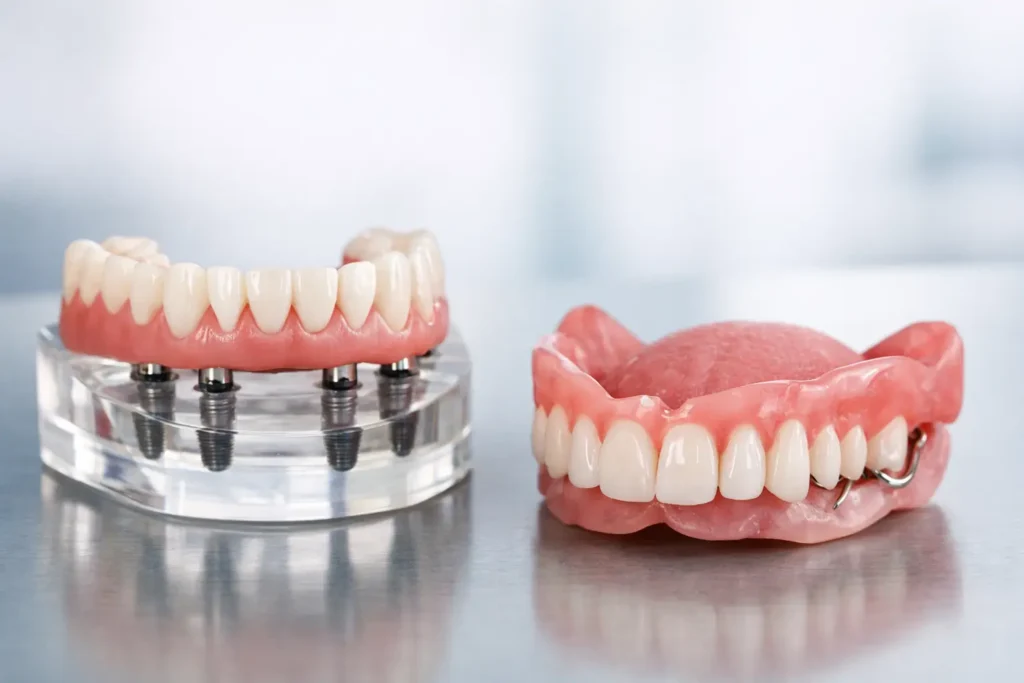
A full set of teeth can change how you eat, speak, smile, and even how willing you are to make travel plans or sit through dinner with friends. When patients are deciding between tooth replacement options, the question usually sounds simple: should I choose dentures or implants? In real life, the better question is more specific – how do all-on-4 and traditional dentures actually compare once you factor in comfort, function, cost, and long-term value?
For many adults considering major restorative work, especially those paying out of pocket, this is one of the most important decisions in the entire treatment plan. Both options can restore a smile. They do not deliver the same day-to-day experience.
All-on-4 vs traditional dentures: the core difference
Traditional dentures are removable prosthetic teeth that sit on top of the gums. They can replace a full upper arch, a full lower arch, or both. They are custom-made and can be an effective solution for patients who want a lower upfront cost and a non-surgical treatment.
All-on-4 is different. It uses four strategically placed dental implants to support a full arch of fixed teeth. Instead of resting on the gums, the prosthesis is anchored to implants placed in the jawbone. That difference affects nearly everything that follows – stability, bite strength, comfort, bone preservation, and maintenance.
If you want the shortest possible version, it is this: traditional dentures are removable and more affordable at the start, while All-on-4 is fixed, more stable, and usually closer to what patients mean when they say they want their teeth to feel normal again.
How each option feels in daily life
This is where the gap becomes very real.
Traditional dentures can look attractive, but many patients need time to adapt. Because they rest on soft tissue, they may shift slightly when chewing or speaking. Upper dentures often have better suction than lower dentures, but lower dentures are the ones patients most often describe as frustrating. Adhesives can help, but they are not the same as true fixation.
All-on-4 generally feels more secure because it is attached to implants. Patients do not remove it at night, and they do not rely on suction or adhesive to keep it in place. That added stability usually means more confidence in conversation and less worry about movement during meals.
Comfort also depends on fit, anatomy, and healing. A well-made denture can absolutely serve a patient well. But if someone is already saying, “I want to avoid a loose plate,” or “I am tired of dealing with slipping dentures,” they are often describing the exact problem All-on-4 was designed to solve.
Eating and speaking: where expectations matter
Many patients compare these options by asking one practical question: what will I be able to eat?
With traditional dentures, eating often requires some adjustment. Soft foods are easier at first. Tough meats, crusty bread, nuts, and sticky foods can be more challenging, especially with lower dentures. Some patients adapt very well over time, while others continue to avoid certain foods because the denture shifts or creates sore spots.
All-on-4 usually allows stronger chewing ability than traditional dentures because the prosthesis is implant-supported. That does not mean every food becomes effortless overnight, but patients typically regain a more natural biting experience and a broader diet.
Speech can improve with either option when missing teeth are replaced, but removable dentures may create a learning curve as the tongue adjusts to the appliance. With implant-supported full arches, speech adaptation is often easier because the teeth stay fixed in place.
Bone loss and facial support
This is one of the most overlooked parts of the all on 4 vs traditional dentures discussion.
When teeth are lost, the jawbone no longer receives the stimulation it once got from tooth roots. Over time, that bone can shrink. Traditional dentures do not stop this process because they sit on the gums rather than stimulating the bone. As the ridge changes shape, dentures may loosen and need relines or replacement.
All-on-4 helps preserve bone because the implants function like artificial roots. That stimulation can reduce the rate of bone loss and help maintain facial structure better over time.
This matters for more than appearance. Bone loss can affect denture fit, comfort, and the overall shape of the lower face. Patients who have worn removable dentures for years often notice that what used to fit reasonably well no longer feels secure. That is not always a denture quality issue. Often, the underlying anatomy has changed.
Cost: upfront savings vs long-term value
Traditional dentures usually cost less upfront. For patients working within a strict budget, that can make them the most realistic starting point. Not every patient wants surgery, qualifies for implants immediately, or is ready for the higher initial investment.
All-on-4 costs more at the beginning because it includes implant surgery, prosthetic fabrication, and a more complex planning process. However, cost should be viewed over the full lifespan of the treatment, not just the first invoice.
Removable dentures often need periodic adjustments, relines, repairs, and eventual replacement as the mouth changes. All-on-4 can involve maintenance too, but many patients find the stability, comfort, and long-term function worth the higher initial price.
For dental tourism patients, this comparison becomes especially important. The savings available through a specialist-led clinic can make advanced treatment far more reachable than it would be at home. That is one reason many US and Canadian patients explore options like full-arch implant rehabilitation rather than assuming removable dentures are their only practical choice.
Surgery, healing, and treatment timeline
Traditional dentures are the simpler path from a surgical standpoint. In some cases, they can be made without implant placement at all, which appeals to patients who want to avoid surgery or need a faster, lower-complexity option.
All-on-4 involves implant placement, so there is a surgical phase and a healing phase. That said, many patients are surprised to learn that immediate-load protocols may allow them to leave with fixed temporary teeth while the implants heal. The exact plan depends on bone quality, oral health, medical history, and whether extractions are needed.
This is where provider experience matters. Full-arch implant treatment is not just about placing four implants. It requires prosthodontic planning, surgical precision, bite design, and careful follow-up. In a setting such as Colina Dental, where multiple specialists, digital planning, and an on-site lab work together, treatment can be more coordinated and efficient for patients traveling from abroad.
Who is a better candidate for each?
Traditional dentures may be the better fit if you want the lowest upfront cost, prefer to avoid surgery, have medical factors that complicate implant treatment, or need a removable solution now while considering future upgrades.
All-on-4 may be the stronger option if you want fixed teeth, are frustrated by the idea of movement or adhesives, want better chewing power, and are looking for a longer-term solution that helps preserve jawbone.
There are also middle-ground cases. Some patients start with dentures and later convert to implant-supported treatment. Others need bone evaluation before knowing whether they qualify for All-on-4. The right answer is not purely about preference. It depends on anatomy, health history, timeline, and budget.
What patients regret most – and what they appreciate most
Patients who choose traditional dentures sometimes regret underestimating the adaptation period. They expected replacement teeth and did not realize how different removable teeth could feel. The most common complaints are looseness, lower denture instability, food limitations, and ongoing maintenance.
Patients who choose All-on-4 most often appreciate the confidence that comes from fixed teeth. They like not having to remove them, not managing adhesive, and not planning meals around what feels safe to chew. Their biggest hesitation is usually the higher upfront cost or anxiety about surgery.
That is why a good consultation should not push one option blindly. It should clarify what daily life will actually look like with each treatment.
All on 4 vs traditional dentures: which should you choose?
If your top priority is affordability today and you are comfortable with a removable appliance, traditional dentures can still be a valid and useful solution. They have helped many patients restore appearance and basic function.
If your top priority is stability, stronger function, and a more natural fixed-teeth experience, All-on-4 is often the better long-term choice. For many patients, especially those replacing a full arch and wanting to avoid the frustrations commonly associated with removable dentures, it is the option that feels closest to getting real confidence back.
The best decision starts with an honest clinical evaluation and a treatment team that explains trade-offs clearly, including what happens not just this month, but years from now. When you understand the difference between lower initial cost and higher long-term value, the choice usually becomes much clearer.
A smile restoration should fit your life, not just your chart. The right option is the one that lets you eat comfortably, speak confidently, and move forward without second-guessing every meal, photo, or conversation.