



If you have ever tried to coordinate a crown, an implant, or a full-mouth plan while also juggling flights and time off work, you already know the real problem is not just dentistry. It is predictability. You want to know what will happen, how long it will take, and whether the result will match what you were promised.
That is exactly where 3D digital dentistry earns its keep. It is not a “nice-to-have” gadget. It is a set of imaging and design tools that helps dentists measure, plan, and build dental work with far less guesswork – especially for patients traveling for care who need an efficient timeline and a clear plan.
What is 3D digital dentistry used for?
At a practical level, 3D digital dentistry is used for three big things: capturing accurate data about your mouth, planning treatment in a way that reduces surprises, and producing restorations that fit more precisely.
Instead of relying only on 2D X-rays, physical impressions, and manual lab steps, a digital workflow may include 3D scans (of teeth and gums), 3D radiology (to see bone and anatomy), and software that allows the dentist to design restorations or surgical plans before anything is made or placed.
For patients, the benefit is usually not “technology for technology’s sake.” The benefit is confidence. You get more clarity about what can be done, what should not be rushed, and what the realistic outcomes are.
The core technologies behind 3D digital dentistry
Most people experience “digital dentistry” as a faster impression or a cleaner scan. Behind the scenes, it is the combination that matters.
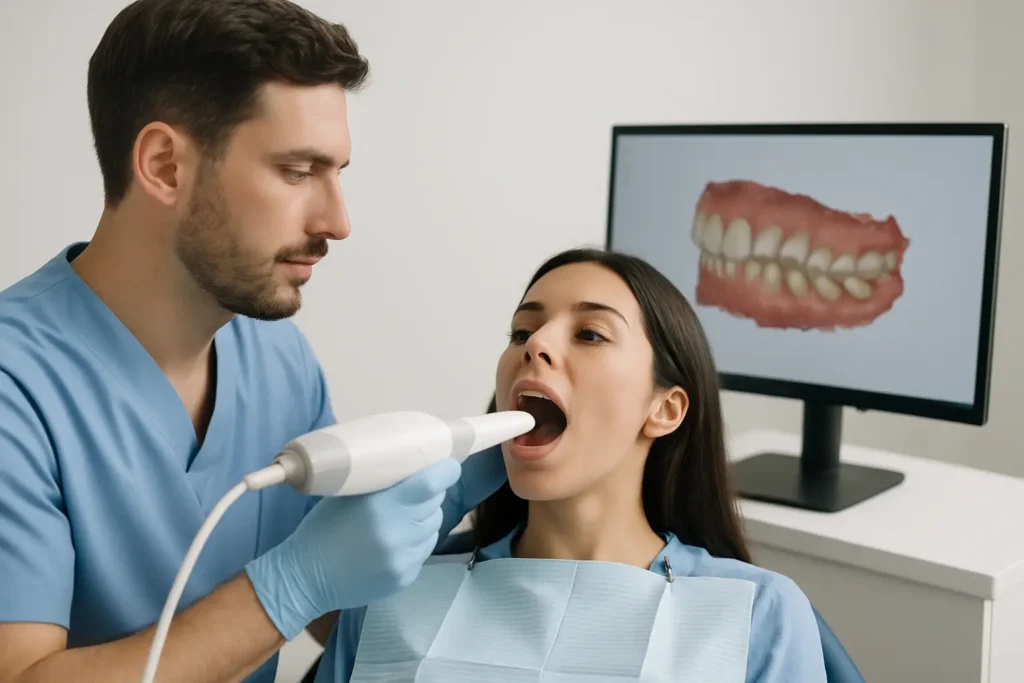
An intraoral scanner creates a 3D model of your teeth and bite. That digital model can be used to design crowns, veneers, bridges, and implant restorations with detailed contact points and margins.
A 3D cone beam CT scan (often called a CBCT) shows your bone volume and density, sinus position, nerve pathways, and other anatomy that simply does not show up well on traditional 2D images. This is especially important for implant planning.
Then CAD/CAM design software links the scan data to what will be made in the lab. When a clinic has an on-site lab, those steps often move faster because the dentist and lab team can collaborate in real time.
Implant dentistry: planning the foundation before surgery
Dental implants are one of the most common reasons patients ask about digital dentistry. They should. Implant treatment is not only about placing a titanium post – it is about placing it in the right position for the final tooth.
With 3D imaging, a dentist can evaluate bone height and width, check proximity to nerves, and plan angles that support a strong, cleanable final restoration. In many cases, this type of planning helps avoid unpleasant surprises like “we do not have enough bone” after you already traveled.
Digital planning can also support guided implant surgery, where a custom guide helps translate a virtual plan into the real procedure. It is not magic, and it does not replace surgical skill. But it can improve consistency, especially in straightforward cases where anatomy and spacing allow.
The trade-off is that guided planning requires excellent scan quality and careful verification. A good clinic will still confirm measurements clinically and will not force a guided approach when visibility, access, or tissue conditions suggest a different method.
All-on-4 and full-arch rehabilitation: coordinating many moving parts
Full-arch implant rehabilitation is where digital dentistry can be a game-changer for patient experience. Treatments like All-on-4 involve implant positioning, bite design, tooth shape, and esthetics – all under a tight functional requirement: you need a stable bite that protects the implants and feels natural.
Digital records help the team coordinate the prosthetic plan with the surgical plan. That means implant positions are selected not only for bone, but also for where the final teeth need to be. When this coordination is done well, it reduces the chance of compromises later, such as bulky prosthetics, hard-to-clean contours, or an unstable bite.
It also helps during transitions. Many full-arch cases include a temporary prosthesis before the final one. Digital design and lab support can improve how those temporaries fit and how quickly adjustments can be made.
It depends on the case, though. Severe bone loss, complex bite collapse, or significant jaw discrepancies may require additional steps that cannot be “digitized away,” such as bone grafting, staged healing, or a longer period in provisionals.
Crowns and bridges: better fit, fewer remakes, clearer timelines
If you are getting crowns or bridges, 3D digital dentistry is often used to capture the tooth preparation accurately and send it directly into design.
For patients, the most noticeable difference is comfort and speed. Digital impressions can be easier than traditional impression trays, and they can reduce the risk of small defects that lead to retakes.
Clinically, the advantage is precision at the margins (where the crown meets the tooth) and more consistent contact points between teeth. When crowns fit correctly, you are less likely to have food traps, sore floss points, or bite issues that require multiple adjustments.
The timeline benefit is real, but it is not automatic. The fastest workflows happen when the clinic and lab are tightly integrated and when the case is straightforward. Complex bridgework, heavy wear, or an unstable bite can still take time because planning and verification matter more than speed.
Porcelain veneers and smile design: previewing change before you commit
Cosmetic dentistry is emotional. Patients are not just buying teeth – they are buying confidence. That is why “guessing” is a bad strategy.
Digital scans and smile design tools are used to plan veneer size, shape, and alignment with your facial features and bite. In many cases, this supports a wax-up or mock-up that lets you see and feel a proposed outcome before final porcelain is made.
The nuance is that digital smile previews are not promises. Lighting, lip movement, gum display, and the translucency of porcelain all influence the final result. A responsible dentist uses digital tools to communicate clearly, then confirms esthetics with real-world try-ins and patient feedback.
Dentures and implant-supported dentures: improving comfort and stability
Traditional dentures can be challenging, especially for lower jaws where stability is harder to achieve. Digital dentistry can help by capturing more accurate anatomy and by designing denture bases and tooth setups more predictably.
Where it becomes especially useful is in implant-supported dentures, such as overdentures. 3D imaging helps determine implant placement relative to bone and anatomy, and digital planning helps ensure attachments and bars align with the intended prosthesis.
Here again, technology supports outcomes – it does not replace the basics. Tissue health, saliva, muscle movement, and patient adaptation still affect denture comfort. A good plan includes realistic expectations and a willingness to fine-tune after delivery.
Root canals and oral surgery: safer planning around anatomy
Patients do not always associate endodontics and surgery with “digital dentistry,” but 3D imaging can matter.
For root canals, a CBCT can help identify complex root anatomy, hidden canals, fractures, or infections that are not obvious on a standard X-ray. It is not required for every case, and it should not be used indiscriminately, but it can be very useful when symptoms and 2D images do not match.
For extractions and oral surgery, 3D imaging can help evaluate impacted teeth, root proximity to nerves, and sinus involvement. That can reduce risk and help set correct expectations for healing time and post-op care.
Orthodontics and aligners: mapping movement with fewer surprises
Digital scans are commonly used for orthodontic records and for clear aligner planning. The value is clarity: the team can evaluate crowding, spacing, bite relationships, and then model proposed movements.
For adults combining orthodontics with restorative work, digital planning helps sequence the steps. Sometimes the “right” order is aligners first, then veneers or crowns. Sometimes it is periodontal treatment first, or implants after orthodontics. The point is that digital models make those decisions more concrete.
The trade-off is that aligner simulations are idealized. Teeth do not always move exactly as the software predicts, especially in cases with significant rotations, missing teeth, or periodontal limitations. Monitoring still matters.
Why this matters for dental tourism patients
If you are traveling from the US or Canada for care, your biggest risks are not usually pain or fear of the dentist. They are logistical and financial: wasted travel days, unclear treatment phases, and the frustration of not knowing whether you will be “done” on schedule.
3D digital dentistry supports faster decision-making because diagnostics are clearer and the plan is easier to communicate. It can also reduce mid-treatment surprises that force changes to the timeline.
That said, the most important variable is still the clinical team. Technology helps excellent specialists do what they already do better. It does not compensate for a rushed exam, weak communication, or a lab that cannot execute the plan.
What to ask a clinic using 3D digital dentistry
If you are comparing options, ask how digital tools show up in your actual treatment plan. Will you receive a CBCT for implant cases? Is the lab on-site or coordinated closely? How are bite records captured and verified? Who is responsible for the design decisions – a general dentist, a prosthodontist, or a specialist team?
And ask the question most patients skip: what happens if the digital plan and real-life conditions do not match? A trustworthy clinic will explain how they confirm findings clinically and how they adapt without sacrificing quality.
If you want a predictable plan for complex care with specialist oversight and an integrated lab workflow, Colina Dental in Escazú has built its process around 3D digital dentistry and coordinated dental tourism support – including optional on-site lodging at Colina Inn. You can start with a free consultation through https://www.colinadental.com/.
A good dental decision feels calm, not rushed. Digital tools can help you get there, but the real win is a team that uses them to give you fewer surprises and more control over your outcome.