



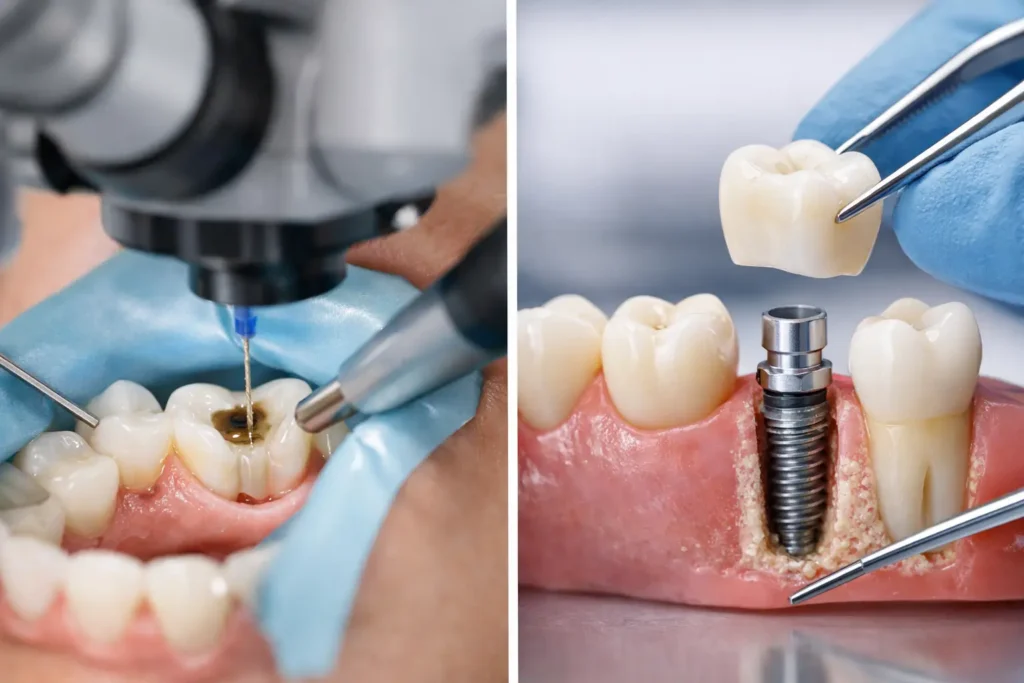
A tooth cracks, starts throbbing, or shows a dark shadow on an X-ray, and suddenly the question gets very real: root canal or extraction and implant? For many patients, the answer is not just about saving a tooth. It is about cost, travel time, healing, appearance, and whether the treatment will still be serving them well years from now.
If you are comparing options because dental care at home feels expensive or rushed, this is where a careful diagnosis matters most. The right choice depends on the condition of the tooth, the surrounding bone and gum support, your bite, your timeline, and your long-term goals.
Root canal or extraction and implant: what is the real difference?
A root canal is designed to keep your natural tooth. The dentist removes infected or inflamed pulp from inside the tooth, disinfects the canals, seals them, and usually protects the tooth with a crown if the structure is weakened. The goal is preservation.
An extraction and implant take a different path. The damaged tooth is removed, the area heals or is prepared for immediate implant placement when appropriate, and a titanium implant replaces the root. A crown is later attached to restore function and appearance. The goal is replacement.
Both treatments can be excellent. Both can also fail if the diagnosis is incomplete or the case is pushed into the wrong category. That is why a blanket rule like “always save the tooth” or “just pull it and place an implant” is too simplistic.
When saving the tooth is often the better choice
If the tooth has healthy surrounding bone, manageable infection, and enough remaining structure to support a restoration, keeping your natural tooth is often the most conservative option. A successful root canal can relieve pain, preserve your natural bite, and avoid surgery.
There is also a practical advantage. In many cases, root canal treatment can be completed faster than implant treatment, especially if implant placement requires grafting or staged healing. For patients traveling from the US or Canada, that timing can matter. Fewer surgical steps may mean a simpler visit and an easier recovery plan.
Natural teeth also provide something no implant can fully duplicate – your own periodontal ligament. That ligament helps with subtle pressure sensing when you chew. Patients do not always notice this day to day, but from a biological standpoint, preserving a healthy tooth is usually worthwhile when prognosis is strong.
That said, “save the tooth” only works when the tooth is actually savable in a predictable way. A root canal on a badly cracked tooth, a tooth with advanced bone loss, or a tooth with too little structure left can turn into repeated treatment and mounting costs.
Signs a root canal may make sense
A root canal is often favored when the tooth is restorable, the crack does not extend hopelessly below the gum line, gum support is stable, and the infection can be controlled. Front teeth and many premolars do especially well when enough healthy tooth remains.
Molars can also be good candidates, but they need careful evaluation. They take more chewing force, often have more complex canals, and may need a well-made crown to last.
When extraction and implant may be the smarter long-term option
Some teeth are technically treatable but poor investments. That is the category many patients wish someone had explained earlier. If a tooth has severe fracture, repeated failed root canal treatment, extensive decay below the gum line, or advanced periodontal damage, removing it and replacing it with an implant may offer a more predictable future.
This is especially true when the tooth would need several procedures just to remain in service. A root canal, retreatment, post buildup, crown lengthening, and crown can add up financially and biologically. If the foundation is weak, spending more to preserve it is not always the most conservative decision.
An implant can also help preserve function when a tooth is beyond repair. Once integrated with the bone, it can provide excellent support for a crown and a stable chewing surface. For many adults who want a durable solution, especially after years of patchwork dentistry, that reliability is appealing.
Still, implants are not instant replacements in every case. Healing time, bone quality, sinus position in upper back teeth, smoking status, uncontrolled diabetes, and grinding habits all affect planning. Good implant treatment is highly predictable, but it is still a surgical treatment with its own risks and timing.
Cases where extraction and implant often win
A tooth with a vertical root fracture is one of the clearest examples. These teeth usually cannot be predictably saved. Teeth with deep recurrent infection after prior endodontic treatment, major structural loss, or severe mobility due to bone loss may also be better candidates for replacement rather than another attempt at rescue.
Cost matters, but value matters more
For many patients, this decision starts with price. That is understandable. In the US and Canada, root canal treatment, crowns, extractions, grafting, and implants can become expensive quickly.
But comparing only the first bill can be misleading. A root canal may cost less upfront than an implant. If the tooth has a strong prognosis, that lower cost can represent excellent value. If the tooth is questionable and needs additional treatment later, the cheaper option today may become the more expensive path overall.
The reverse can also happen. Some patients assume implants are always the premium choice and therefore automatically better. They are not better simply because they cost more. If a tooth can be saved predictably, removing it too soon is overtreatment.
The better question is not “Which is cheaper?” It is “Which option has the better long-term prognosis for this specific tooth?” That is the conversation a specialist-led practice should help you have.
Travel timing changes the conversation
For dental tourism patients, treatment planning has an added layer. You are not only choosing between procedures. You are choosing between timelines.
A root canal and crown can sometimes fit within a shorter visit, depending on the condition of the tooth and the clinic’s workflow. An extraction with immediate implant may work in one trip for the surgical phase, but the final crown often comes later after healing. If bone grafting is needed, the process may extend further.
That does not make implants inconvenient. It simply means the plan should be built around your schedule from the beginning. A clinic experienced in treating international patients should explain what can be completed during your stay, what healing milestones matter, and whether your case benefits from one trip or a staged approach.
At Colina Dental, this kind of coordination is central to care because complex restorative treatment is not just clinical. It is logistical. Patients want clarity before they board a plane.
Root canal or extraction and implant: the factors dentists weigh
The best treatment plans come from diagnosis, not preference. Dentists typically look at the amount of remaining tooth structure, the depth and type of fracture, gum and bone support, location in the mouth, bite forces, infection pattern, esthetic demands, and your medical history.
A CBCT scan may be useful in more complex cases because two-dimensional X-rays do not always reveal the full picture. Hidden fractures, bone defects, and failed prior treatment are easier to evaluate with advanced imaging. That matters because the wrong decision often starts with incomplete information.
Your personal priorities count too. Some patients want the most conservative biological option. Others want the most predictable long-term restoration even if it takes more time. Neither goal is wrong.
What patients often misunderstand
One common misconception is that implants never fail while root canals are risky. In reality, both can succeed for many years when case selection is good and the treatment is done well. Both can also fail when maintenance is poor or the original diagnosis missed a bigger issue.
Another misunderstanding is that pain tells you which treatment you need. Pain tells you something is wrong, but not necessarily whether the tooth should be saved or removed. Some hopeless teeth hurt very little. Some treatable teeth hurt a lot.
There is also the belief that extraction is a clean reset. It can be, but once a tooth is removed, the body starts remodeling the bone in that area. That is one reason timing and surgical planning matter. Preserving bone is part of preserving future options.
The best next step is a clear diagnosis
If you are weighing root canal or extraction and implant, resist the urge to decide based on fear, one price quote, or a general rule you saw online. Teeth do not read rules. They respond to anatomy, infection, load, and biology.
A careful exam by the right specialists can tell you whether your tooth has a strong future or whether replacement is the more honest recommendation. That kind of clarity is especially valuable when you are planning treatment away from home and want confidence in both the dentistry and the process.
The right answer is the one that gives you the best chance to chew comfortably, protect your bone and gums, and avoid repeating the same problem a year from now. A good treatment plan should feel less like a sales pitch and more like a well-supported path forward.