



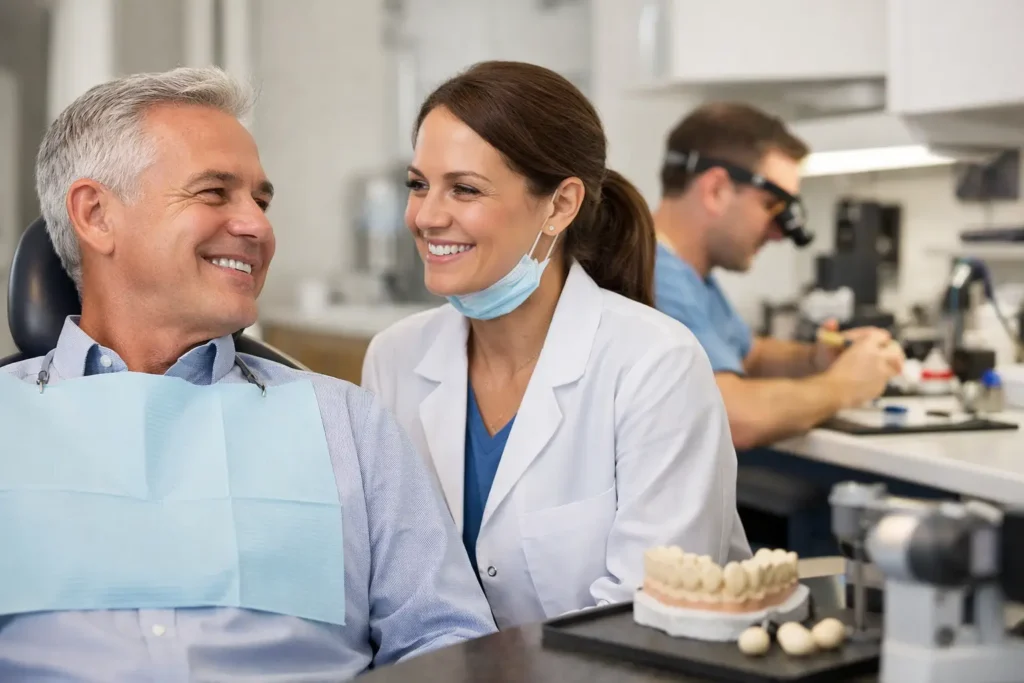
If you are traveling for crowns, veneers, implants, or full-mouth restoration, time matters almost as much as treatment quality. That is why on site dental lab benefits for patients are more than a convenience – they can directly affect fit, timing, comfort, and how confidently your case moves from planning to final delivery.
For many patients from the US and Canada, the biggest concern is not only cost. It is whether everything can be handled efficiently while they are away from home. When a clinic has its own lab in the same facility, the process becomes more coordinated. The dentist, specialists, and lab technicians can work together in real time, which often means fewer delays and fewer surprises.
Why on site dental lab benefits for patients matter
A dental restoration is not a one-size-fits-all product. A crown, veneer, denture, bridge, or implant prosthesis has to match your bite, your smile, and the clinical realities of your mouth. When the lab is off site, communication usually travels through photos, written notes, scans, shipping timelines, and return appointments. That can work well, but it introduces more handoffs.
An on-site lab reduces those handoffs. If a crown needs a small contour adjustment, if a shade needs refinement, or if a denture needs a pressure point relieved, the clinician can often speak directly with the technician the same day. For the patient, that may translate into less waiting and a more personalized result.
This is especially valuable in complex cases. Full-arch implant work, multiple crowns, cosmetic smile design, and combination restorative cases often require coordination between several professionals. When the restorative team and the lab are under one roof, decisions can be made faster and with more precision.
Faster turnaround without sacrificing control
One of the clearest on site dental lab benefits for patients is speed. That does not mean rushing treatment. It means removing unnecessary downtime.
In a traditional setup, impressions or digital scans are sent to an external lab. The restorations are fabricated elsewhere, shipped back, tried in, and sometimes sent out again for changes. Every extra step adds time. If you live nearby, that may be manageable. If you are flying in for care, it can affect your entire travel schedule.
With an on-site lab, many steps can move forward immediately. A technician can review the case while the dentist is still available. Small modifications may be made the same day. Temporary restorations can often be refined more quickly. In some cases, final restorations can be delivered in a shorter treatment window, which is a major advantage for dental tourism patients trying to minimize time away from work, family, or home.
That said, faster is not always better if biology needs more time. Implant healing, gum conditioning, and certain complex reconstructions still require proper staging. The real benefit is not instant dentistry. It is a more efficient process when timing allows it.
Better fit and esthetics through direct collaboration
A beautiful restoration is part art, part engineering, and part clinical judgment. The closer the communication between doctor and technician, the easier it is to fine-tune details that patients notice immediately.
Shade matching is a good example. Tooth color is not just one flat tone. It includes translucency, brightness, texture, and how the restoration looks in different lighting. When the lab is on site, the technician may be able to see the patient directly or receive immediate guidance from the treating doctor. That can improve the final esthetic result, especially for front teeth and veneers.
Fit matters just as much. A crown that is technically acceptable on paper may still need minor bite adjustments or contour changes to feel natural. An implant bridge may need refinement for speech and comfort. A denture may need balancing to reduce sore spots. When these adjustments can happen quickly, the patient often experiences a smoother delivery appointment and a better final outcome.
Fewer appointments and fewer return trips
For local patients, convenience is always welcome. For international patients, it can make the treatment plan far more practical.
Every additional appointment affects transportation, lodging, time off work, and stress. If an outside lab delay pushes a case back, the patient may need to extend a stay or return later than expected. An on-site lab helps reduce that risk because many issues can be addressed internally rather than sent out and queued elsewhere.
This matters most in treatment categories where timing is central, such as cosmetic cases, multiple-unit crown work, and implant prosthetics. It is also a major benefit when a patient is coordinating care around flights. A clinic that combines specialist care, digital planning, and in-house lab support can often create a treatment schedule with fewer unknowns.
For dental tourists, predictability is a form of comfort. Patients want to know that their time is being respected and that the clinic has the systems in place to complete treatment efficiently.
More quality control in complex treatment
When a clinic manages diagnostics, specialists, and lab work together, there is stronger continuity from start to finish. That does not guarantee perfection, but it usually supports better oversight.
Consider a full-mouth reconstruction. The prosthodontist may be focused on bite design and final esthetics. The periodontist or surgeon may be managing implant placement and tissue health. The lab technician is translating that plan into something the patient will actually wear every day. If those team members are coordinating closely, treatment tends to be more cohesive.
This is one reason established, multi-specialty practices invest in integrated workflows. Instead of treating the lab as a distant vendor, they treat it as an active part of patient care. That can make a meaningful difference when there are many moving parts.
Patients should also understand the trade-off. Not every case must be made in an on-site lab to be excellent. Some highly specialized external labs do beautiful work. What matters is the quality of communication, the standards of the clinic, and the experience of the team. Still, for many restorative and cosmetic cases, having the lab on site offers practical advantages that patients can feel directly.
Why this matters even more for dental tourism
Traveling for dentistry changes how people evaluate care. They are not only asking, “Is this treatment good?” They are also asking, “Can this be completed efficiently, safely, and with fewer complications while I am away from home?”
That is where on-site lab support becomes a genuine value point. It helps shorten the distance between diagnosis and delivery. It supports same-location problem solving. It can reduce the chance that a minor adjustment turns into a major scheduling issue.
At a clinic built around dental tourism, these details matter. Patients want specialist-led care, clear treatment planning, transparent costs, and help coordinating the trip itself. They also want to feel that the clinic understands the realities of traveling for major dentistry. An on-site lab fits naturally into that model because it supports speed, control, and a more comfortable overall experience.
At Colina Dental, this integrated approach is part of what makes treatment more manageable for guests visiting Costa Rica for advanced restorative and cosmetic care. When clinical expertise, digital dentistry, and lab support work together in one place, patients can move through treatment with greater confidence.
What patients should ask before choosing a clinic
If you are comparing providers, ask how the lab fits into the treatment process. Is the lab truly on site? Do the dentist and technician collaborate directly? How are adjustments handled if something needs refinement? How many visits are typically required for your type of case? These questions can tell you a lot about how efficiently the clinic operates.
You should also ask about the team behind the work. An on-site lab is only as valuable as the professionals using it. Experience, case planning, digital tools, and specialist oversight still matter. The best outcomes come from a well-coordinated team, not from one feature alone.
For patients considering treatment abroad, efficiency is not a luxury. It is part of safety, comfort, and peace of mind. When your care is complex and your time is limited, an on-site dental lab can help turn a stressful process into one that feels organized, responsive, and well supported.
If you are planning major dental work, look beyond the price quote and ask how the clinic actually gets the work done. The answer often tells you what your experience will feel like once you are in the chair.