



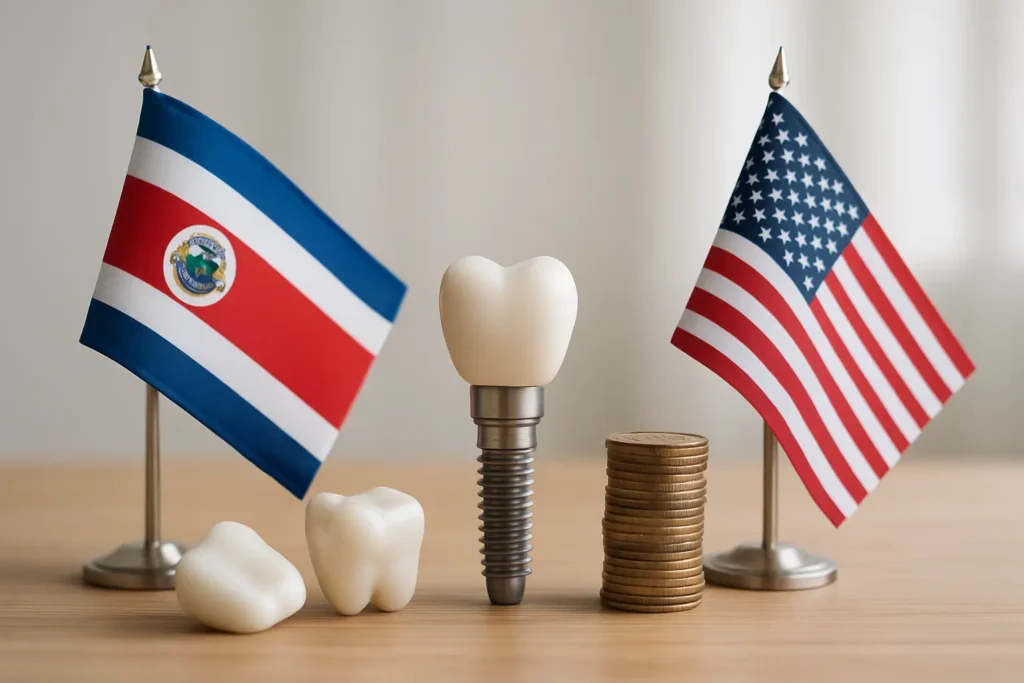
If your dentist in the US quoted you a number that feels more like a used car than a tooth, you are not alone. Dental implants are one of the most predictable long-term solutions in dentistry, but they are also one of the least “insurance-friendly” procedures in America. That gap between what people need and what they can reasonably pay is exactly why Costa Rica has become a serious option for patients who want high clinical standards without the US price tag.
Below is a clear, decision-focused look at costa rica dental implants cost compared to usa, including the “why” behind the numbers, what can quietly raise or lower your total, and how to think about travel so you can plan with confidence.
Costa Rica dental implants cost compared to USA: real-world ranges
Implant pricing is never one number, because the implant itself is only one piece of a larger plan. In most cases, you are paying for three main components: the implant fixture (the “root”), the abutment (the connector), and the crown (the tooth you see). Add imaging, surgical time, and follow-up care, and pricing spreads out quickly.
In the US, a single implant with crown commonly lands in the $3,500 to $6,500 range per tooth, depending on region, provider type, and whether additional procedures are needed. Major metro areas and specialist-led practices often trend higher, and the final figure can climb further if you need bone grafting, sinus lift, or extractions.
In Costa Rica, many US and Canadian patients find that comparable implant treatment is often 40% to 70% less than typical US pricing, even when the work is performed by specialists using modern digital planning. That does not mean every case is “cheap” – complex cases are still complex – but it can mean the difference between postponing care indefinitely and completing treatment on a timeline that actually works.
The important comparison is not “lowest price.” It is the total value equation: clinical team, materials, diagnostics, lab quality, treatment coordination, and the predictability of the plan.
Why implants cost so much more in the US
US implant fees are not just about the implant hardware. They reflect a broader cost structure.
First, overhead is higher. Facility costs, staffing, insurance administration, and regulatory burdens add up. Second, US implant dentistry often depends on multiple providers and multiple locations – a surgeon places the implant, another office restores it with the crown, a separate imaging center takes the CBCT scan, and a lab somewhere else fabricates the final crown. When the workflow is fragmented, each step has its own pricing.
Third, many US patients are paying mostly out of pocket. Even when you have dental insurance, implants are frequently limited, partially covered, or excluded. The result is that implant dentistry in the US becomes a high-cost purchase with little financial cushioning.
Costa Rica’s advantage is not “cut corners.” It is a different cost environment, often paired with integrated treatment models designed for international patients.
What your quote includes – and what it might not
Implant pricing gets confusing fast because quotes are not standardized. Two plans can look similar on paper and still lead to very different totals.
A strong implant estimate should clearly state whether it includes the surgical placement, any grafting, the abutment type, the crown material, imaging, anesthesia or sedation options, and follow-up visits. If you are comparing the US to Costa Rica, make sure you are comparing full scope to full scope.
Also ask about the lab workflow. Crowns and bridges are not generic commodities. The skill of the lab technician and the quality control process influence fit, bite, and aesthetics – which affects comfort and longevity.
The biggest factors that change implant pricing
There is no way to judge an implant quote without understanding what is driving it. A few variables have outsized impact.
Bone grafting and sinus lifts
If you have lost bone volume, your implant may require grafting to create stable support. Upper back teeth can also require a sinus lift. These procedures can meaningfully increase cost in the US and abroad, and they can add time to the treatment sequence.
Implant brand and component system
Not all implant systems are identical. Reputable clinics typically use established implant brands with documented performance. The brand affects component availability and long-term serviceability, especially if you ever need maintenance after returning home.
Specialist involvement
Cases involving limited bone, bite issues, or cosmetic demands can benefit from a multi-specialty team approach. It is worth asking who is placing the implant and who is restoring it. A predictable outcome is rarely an accident.
Single tooth vs full-arch solutions
A single implant is one kind of plan. A full arch is another. Patients who have failing teeth across an arch may be candidates for full-arch implant rehabilitation (often referred to as All-on-4 style solutions), which can be more cost-efficient per tooth than replacing teeth one by one. The treatment planning is more complex, but the transformation is also more complete.
Travel costs: the part people forget to calculate
When patients compare costa rica dental implants cost compared to usa, they often focus only on the dental fee. Travel has a cost too, and it should be included in your decision.
For most patients coming from the US, travel expenses include airfare, lodging, meals, and local transportation. The good news is that even after factoring in travel, many patients still see meaningful net savings – especially for multi-unit cases like several implants, implant bridges, or full-arch treatment.
Timing matters. Implants are not typically a “one and done” procedure. Depending on your case and the protocol recommended, you may need two visits: one for surgery and one later for final restoration. Some patients can be restored faster, but many need a healing period for predictable integration. A reputable clinic will tell you what your timeline realistically looks like.
How to compare clinics without guessing
If you are making a medical decision based on another country, you deserve more than marketing language. The easiest way to reduce uncertainty is to evaluate the same criteria you would use at home, and then add travel-specific questions.
Look for transparency in the treatment plan, clear communication on timelines, and a defined specialist team. Ask what diagnostic imaging is used, how treatment is digitally planned, and how the lab work is produced and checked. If your case is complex, ask how multiple specialties coordinate.
Just as importantly, ask what happens after you go home. A solid plan includes guidance for hygiene, bite protection if needed, and follow-up protocols. The goal is not just to “finish” the work. It is to make sure the work lasts.
Where Costa Rica can be the smarter financial move
Costa Rica tends to be most compelling for patients who need more than one unit of care. A single implant can still be worth traveling for, but the value becomes clearer as treatment scope expands.
If you need multiple implants, an implant bridge, or full-arch rehabilitation, the savings can be substantial. Patients also appreciate the ability to consolidate dentistry that might take many appointments in the US into a more coordinated schedule, especially when the clinic has in-house imaging and an on-site lab to reduce delays.
For patients who are anxious about logistics, a dental tourism-focused model can remove friction: scheduling, airport pickup guidance, lodging coordination, and a care team that treats you like a guest instead of a number.
When staying in the US may make more sense
It depends, and it is worth saying out loud.
If you have significant medical complexities that require close coordination with your physician, or you cannot travel comfortably, you may be better served locally. If you have a trusted US specialist you love and your insurance meaningfully offsets the cost, staying home can be the simplest path.
Also, if you are looking for the absolute lowest price anywhere, you can end up in risky territory. Implant dentistry is a surgical-restorative partnership. The wrong plan, rushed sequencing, or poor prosthetic design can turn “cheap” into expensive very quickly.
A practical way to estimate your true total
The most helpful exercise is to compare totals using the same scope.
Start with your US plan and request it in writing with codes and a breakdown: imaging, implant placement, abutment, crown, grafting, anesthesia, and follow-ups. Then request a Costa Rica treatment plan based on your records, ideally including a review of your X-rays or CBCT if available. If you do not have a CBCT, ask whether one will be taken as part of the diagnostic workup.
Then add travel. Be honest: include flights, lodging, meals, and a cushion for an extra day or two. Compare that full figure to your US total. That is the comparison that actually answers the question, not just a per-implant headline number.
Choosing a clinic built for international patients
Dental tourism works best when the clinic is structured for it. That means clear scheduling, predictable turnaround, a specialist roster that can handle complications, and communication that does not disappear after you board your return flight.
For US and Canadian patients who want that kind of coordinated experience in San Jose, Costa Rica, Colina Dental is known for specialist-led care, integrated treatment planning, and an established dental tourism model that pairs clinical depth with hospitality support.
If you are comparing options, prioritize the clinics that show you exactly who is on your case, how your plan is designed, and what your timeline looks like before you commit.
The decision that keeps paying you back
Implants are not a bargain purchase. They are an investment in eating comfortably, smiling without second-guessing, and protecting the bone and bite you will live with for decades.
If you are considering Costa Rica because the US pricing feels out of reach, let the math be honest and the standards be non-negotiable: get a clear plan, confirm who is providing each step, and choose the option that makes you feel calm about both the care and the process. When you do that, the savings are not just financial – they are the relief of finally moving forward.