



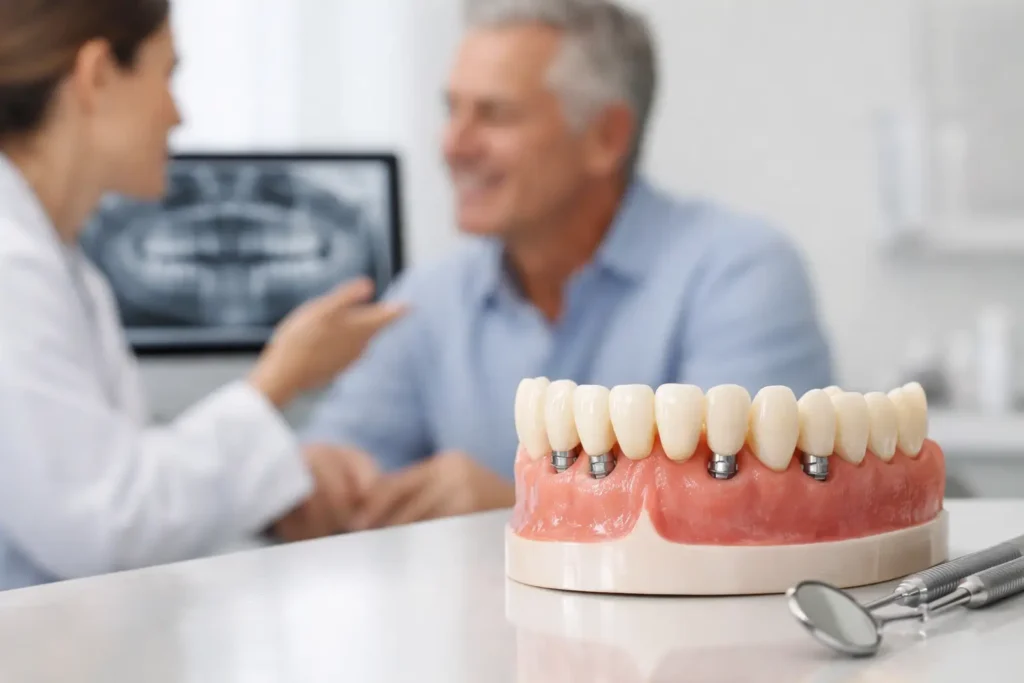
Losing most or all of your teeth changes more than your smile. It changes how you eat, how clearly you speak, and how comfortable you feel making plans, taking photos, or sitting down to dinner with other people. That is why an all on 4 case study full arch restoration matters – it shows what treatment actually looks like for a real patient, not just what it promises on paper.
For many adults in the US and Canada, the decision is not only clinical. It is practical. They want a fixed solution, they want experienced specialists, and they want to know whether the process can be done efficiently without sacrificing quality. A full-arch implant case gives the clearest picture of what to expect.
What an all-on-4 full arch restoration is really solving
All-on-4 is designed for patients who need to replace an entire upper or lower arch, or both. Instead of placing an implant for every missing tooth, four strategically positioned implants support a full fixed prosthesis. In many cases, the back implants are angled to maximize available bone and reduce the need for more extensive grafting.
That matters because many full-arch patients are not starting from an ideal place. They may have advanced decay, failing bridges, loose dentures, gum disease history, bone loss, or a combination of all four. What they need is not a cosmetic patch. They need a stable reset.
The strongest benefit of this treatment is efficiency. It can often provide a fixed provisional bridge quickly, followed by a final restoration after healing. The trade-off is that case selection and planning have to be exact. Not every patient is a good fit for the same protocol, and the best results come from specialist-led evaluation rather than one-size-fits-all treatment promises.
All on 4 case study full arch restoration – a realistic patient example
Imagine a 62-year-old patient from the US who has spent years managing failing dental work. The upper teeth have multiple crowns and recurrent decay. The lower arch has missing teeth, a removable partial denture, and several teeth with poor long-term prognosis. The patient is tired of repeated repairs and wants a fixed, dependable solution.
At the consultation stage, the first priority is not selling the procedure. It is determining whether the mouth is healthy enough, and whether enough bone is present, to support immediate or staged treatment. A full exam typically includes digital imaging, bite analysis, periodontal evaluation, and prosthetic planning. If the patient has active infection, unstable gum health, or a medical issue that affects healing, those factors have to be addressed upfront.
In this case, the scan shows that the upper arch can be restored with an All-on-4 approach without major grafting. The lower arch also appears suitable, though one area requires careful planning because of bone anatomy near the nerve. This is where experience matters. Full-arch implant work is not just about placing implants. It is about placing them in positions that support a functional bite, natural-looking teeth, and a restoration that can be maintained over time.
Phase 1 – Digital planning and case design
Before surgery, the team maps out implant positions and restorative goals. The patient and clinicians discuss tooth shape, smile line, lip support, and bite relationship. This stage is easy to underestimate, but it is one of the biggest reasons some outcomes feel natural and others do not.
A patient with worn-down teeth and collapsed bite often needs more than replacement teeth. They may need the proper vertical dimension restored so the face looks supported again. If that step is rushed, the smile can look bulky, speech can feel off, or chewing forces may not be distributed well.
An on-site lab can make a meaningful difference here because adjustments between surgery, provisionalization, and final restoration happen faster and with more control. That is especially useful for patients traveling for care and trying to keep the process efficient.
Phase 2 – Surgery and immediate provisional teeth
On surgery day, failing teeth are removed, the arches are prepared, and the implants are placed. If initial stability is strong enough, a temporary fixed bridge can often be delivered soon after. For patients who have been wearing removable dentures, this is usually the turning point emotionally as much as physically.
They leave with fixed teeth rather than a removable appliance. They can smile without worrying about movement. They can speak with more confidence. That does not mean they are immediately back to normal eating. Healing still matters, and the provisional bridge must be protected while the implants integrate.
This is where expectations need to stay realistic. Immediate teeth are not the same as final teeth. They are functional and esthetic, but they are part of the healing phase. Patients still need a soft-food diet, careful hygiene, and follow-up visits.
Phase 3 – Healing, monitoring, and final restoration
Over the next several months, the implants integrate with the bone. During this period, the team monitors tissue healing, bite stability, and the condition of the provisional bridge. Small adjustments are common. They are not signs of failure. They are part of refining a complex restoration.
Once healing is confirmed, records are taken for the final prosthesis. This is where long-term comfort and appearance are dialed in. The final bridge is stronger, more polished, and designed for daily function. Depending on the case, the material selection may vary based on bite force, esthetic goals, and budget.
In our example, the patient moves from years of unstable dentistry to two fixed full arches that feel secure, look balanced, and let them return to a normal social and eating routine. The result is not only a better smile. It is a better baseline for daily life.
Why patients look for this treatment outside the US
A full-arch implant case in the US can become financially out of reach very quickly, especially when extractions, temporaries, imaging, sedation, and final prosthetics are included. For many patients, the issue is not whether they want treatment. It is whether they can justify the cost.
That is why dental tourism has become a serious option for full-mouth rehabilitation. The right clinic can provide specialist care, modern technology, and a coordinated treatment plan at a much lower overall cost. The wrong clinic can create more uncertainty than savings.
Patients considering treatment abroad usually want three things answered clearly. Who is doing the work? How is the case planned? What support is available while they are in the country?
A clinic built for international patients should be able to answer all three without hesitation. That includes specialist credentials, digital diagnostics, restorative coordination, and practical travel support. At Colina Dental, that coordinated approach is part of the treatment experience, which helps reduce the stress that often comes with a major full-arch case.
Who is a good candidate for All-on-4
The best candidate is someone who needs full-arch replacement and wants a fixed alternative to dentures. Many patients have multiple failing teeth, severe wear, or old bridgework that no longer makes sense to repair one tooth at a time.
Good candidates also need enough bone for implant stability, or at least anatomy that allows the case to be planned predictably. General health matters too. Smoking, uncontrolled diabetes, clenching, and untreated periodontal disease can all affect outcomes. None of these automatically rule treatment out, but they may change the timeline or the type of restoration recommended.
This is also where the phrase All-on-4 can be slightly misleading. Some patients do best with four implants. Others may need more support. The right number is the one that gives the safest and most durable result, not the one that fits a marketing label.
The trade-offs patients should understand
Full-arch implant restoration is a major upgrade from removable dentures, but it is still a prosthetic solution that requires maintenance. Patients need to clean underneath the bridge properly, attend follow-up visits, and understand that components may need service over time.
There is also an adjustment period. Speech may feel different at first. Chewing comfort improves over time. Soft tissue contours and bite details often need fine-tuning between the temporary and final phases.
That said, most patients who have lived with failing teeth or unstable dentures view these trade-offs as very manageable. They are exchanging constant inconvenience for a stable long-term solution.
What to ask before starting your own case
If you are considering this treatment, ask how your case will be planned, whether a prosthodontic or restorative specialist is involved, what type of temporary restoration is included, and what the healing timeline looks like. Ask who handles extractions, implant placement, and final prosthetic design. Ask what happens if your anatomy suggests a modified approach.
Clear answers are a good sign. Vague promises are not.
The best all-on-4 case study full arch restoration is not the one with the flashiest before-and-after photos. It is the one built on solid diagnostics, realistic planning, and a team that treats the patient like a person, not a package. If you are ready to replace uncertainty with a clear path forward, start with a consultation and get the facts for your specific case.